Previous lot Add to wishlist Place bid now Next lot


292nd Auction: Watches
on
October 24th 2026
In 19 days, 16:30 o'clock
Save date
Place:
Süderstrasse 282
20537 Hamburg
Preview times:
Monday, October the 12th to Friday, October the 23rd from 11-17 o'clock
Please make an appointment with us.
No preview during the auction!
 Bidform »
(PDF 205 KB)
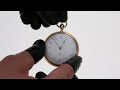
292-4337 Pocket watch: significant, important early Breguet with repeater and ruby cylinder, rare special case, with extract
Ca. Ø49mm, ca. 92.3g, 18K gold, extremely rare special case shape, à-goutte rim fluted on both sides, very solid quality, Tavernier case maker’s mark No. 2487, Breguet mark 1844, dome signed Breguet 1844, ruby cylinder movement with quarter repeater, original enamelled dial with secret Breguet 1844 signature, Breguet steel hands, tiny chip on the dial screw, otherwise in excellent condition and in working order. According to the Breguet certificate, sold in 1806 for 1,800 francs to Monsieur Stefanaki. This case design is extremely rare. The watch bears a resemblance to the technically identical No. 1736 belonging to Prince Troubetzkoi, which was auctioned in 1991 for 42,000 Swiss francs. It is likely that this case design was manufactured specifically for Eastern European clients. Prince Stefanaki was a prominent Breguet client and purchased several important Breguet watches. Knjaz Stefan Bogoridi, known as Stefanaki Bey (Prince Stefanaki) Stefan Bogoridi was born in Kotel in 1775 and died in Istanbul on 1 August 1859. He was a grandson of Sophronius of Vraza, brother of Atanas Bogoridi and father of Aleksandar and Nikola Bogoridi. Stefan Bogoridi was a Phanariot of Bulgarian origin, a foreign policy adviser to two sultans and a member of the Tanzimat Council. As a young boy, he was sent by his family to Bucharest to attend the famous Colegiul Sfântul Sava, where he replaced his birth name, Stojko, with Stefan. He adopted the name Bogoridi in honour of Tsar Boris I. After leaving college, Bogoridi worked for several years as a teacher in Istanbul. In 1799, he joined the Ottoman Navy as a dragoman. In 1812, he was brought to Moldavia by Prince Scarlat Callimachi. There, until 1819, he served as prefect of Galați on the lower Danube, where a large Bulgarian community in exile lived. During the Filiki Eteria and the subsequent Greek Revolution, Bogoridi governed Wallachia as kaymakam (a kind of governor) from the autumn of 1821 until July 1822. Following the counter-offensive by Ottoman troops, he was appointed kaymakam of the Principality of Moldavia in 1822. Between 1823 and 1828, he once again served as dragoman in the Ottoman fleet. Following the Russo-Ottoman War (1828–1829), he took part in the negotiations for the Treaty of Adrianople as a member of the Ottoman delegation. In recognition of his services during this period, he was appointed foreign policy adviser by Sultan Mahmud II. Over the following 30 years, he was involved in all major decisions and negotiations at the Sublime Porte. Stefan Bogoridi was one of the signatories of the London Protocol, which sealed Greece’s sovereignty. During this period, Sultan Mahmud II elevated Bogoridi to the rank of knjaz (German: Fürst; Turkish: Bey). In 1834, he was appointed by the Sultan as governor of the island of Samos. Bogoridi renamed the island’s capital, Vathy, to Stefanopolis. Under Abdülmecid I, Bogoridi not only remained an adviser to the Sultan but also became a member of the Tanzimat Council. He was regarded as one of the most influential reformers and played a key role in reforming the millet system, ensuring that the non-Muslim population of the Ottoman Empire was granted greater rights.
Limit: 27.000 €
Estimate: 50.000 €
 Seite auf Deutsch anzeigen
 Flip Catalogue »
